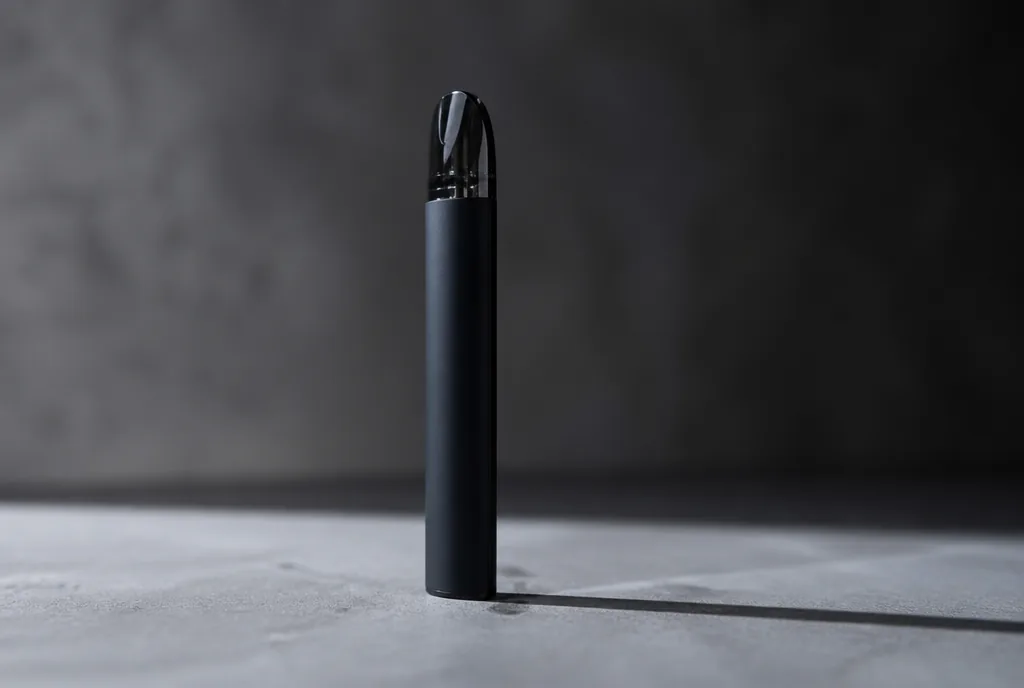
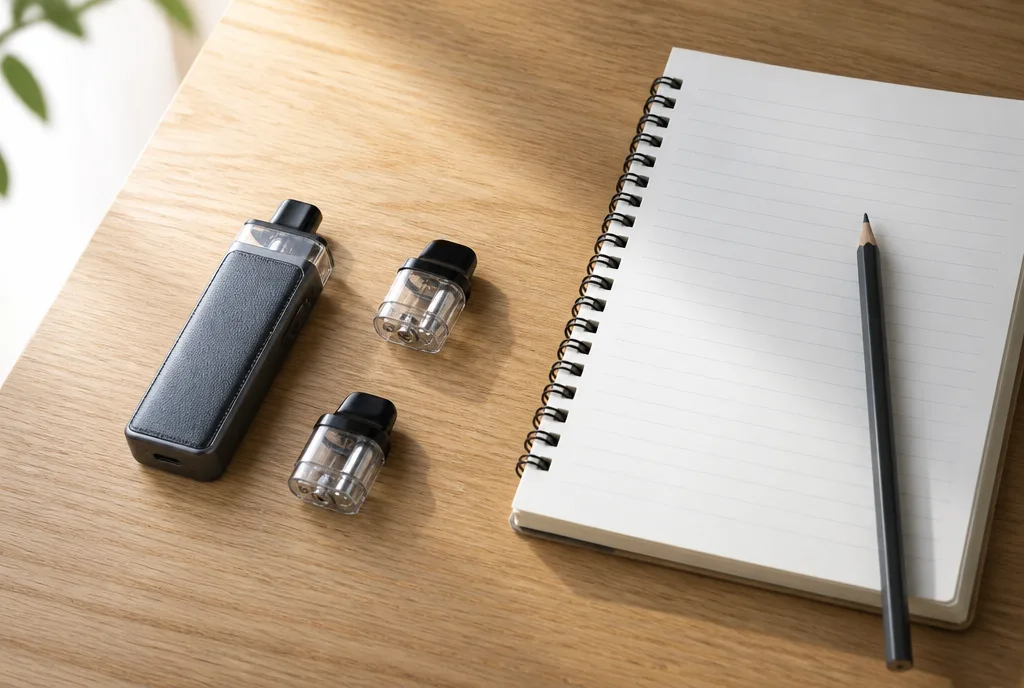
Aspire Nexi Pro, a logbook for a pod with two batteries

A pod that lives inside its own battery changes the way you think about charging. With the Aspire Nexi Pro, the pen no longer sets the pace of trips to the wall socket, the case that recharges it does. Two batteries, a sealed pod and no settings make for very few figures, yet they get muddled quickly when kept in your head. Here is what the manufacturer states, and how to keep a logbook for it, page by page.
Aspire Nexi Pro, what the manufacturer’s specification says
The Aspire Nexi Pro pairs a draw-activated pen, a 2 ml pod and a battery case that the pen slides into to recharge. Aspire’s official product page gives the figures below, and they fill the first page of the logbook.
| Part | Figure stated by Aspire |
|---|---|
| Pen | built-in 350 mAh battery, activated by drawing |
| Case (power bank) | 1650 mAh, Type-C at up to 2 A, battery percentage display |
| Stated recharges | up to 6 full recharges of the pen from the case |
| Pod | 2 ml, side fill, 1.2 ohm mesh coil, not replaceable |
| Dimensions | pen 76.5 x 16.9 x 13.4 mm, case 103.8 x 35.5 x 22.5 mm |
Retailer listings show the same box contents, namely the pen, the case, one 1.2 ohm pod, a USB-C cable and a manual, and describe the kit as a tight mouth-to-lung (MTL) device with no button and no settings. That leaves almost nothing to record on the hardware side, and puts all the attention on power and pods.
A two-battery pod needs two columns
This is where the format parts company with an ordinary pod kit, and where memory lets you down most often. Two stores of energy drain at different speeds, and a single “charged” note never says which one it was.
The case is the real energy reserve
On a standard pod, one battery runs down and goes back on the cable. Here the 350 mAh pen runs down first and returns to its case, which drains more slowly before it, in turn, goes on the mains.
The logbook therefore keeps two separate columns. The first counts the pen’s trips back into the case, the second the case’s own charges on the cable. Your reference point is the case’s percentage display, read at the moment you plug it in.
Six recharges, a figure worth checking
The specification claims up to six full recharges of the pen from the case. A quick sum puts that in perspective. Six times 350 mAh is 2100 mAh, which is more than the 1650 mAh in the case, before any energy lost in conversion is counted.
The “up to” therefore suggests the figure assumes a pen that is rarely run flat, something no product page spells out. That is exactly what the logbook measures. Counting how many times the pen went back into the case between two wall charges gives you a figure based on how you actually use it, which is more useful than the catalogue value.
The pages of an Aspire Nexi Pro logbook
Three pages are enough, each filled in within seconds when something happens. Keeping them separate stops a pod entry from getting lost among the charging notes.
The identity page
It holds the colour, the date the kit went into service and where it came from. It is filled in once and then left alone, unless a second pen or a replacement case joins the logbook.
The box contains a single pod. The date of its first fill closes the identity page and opens the pod page, which gives both records the same starting point.
The power page
One line for each wall charge of the case. It holds the date, the percentage shown before plugging in and the number of times the pen has returned to the case since the previous charge.
Those three values are all you need. After a few lines, the column of returns settles on an average, and that average, more than the percentage, tells you how the case is really holding up. A pen charged on the cable outside the case also gets a quick mark, so the count is not thrown off.
The pod page
The 1.2 ohm mesh coil is built into the pod and cannot be replaced on its own. The logbook therefore follows the whole pod, on a line holding the date of first fill, the liquid used, the date it came out and the reason.
Four reasons cover most cases (burnt taste, fading flavour, leak, planned change). Letting the cotton soak before the first draw is a general precaution with any new pod, and a box ticked on that line lets you check later whether a pod retired early was simply started in a hurry.
A retailer’s published test notes that the remaining e-liquid level is hard to see. A column for the date of each fill makes up for it, since it shows how long the pod has been running without you having to judge the level by eye.
A puff that stops abruptly does not deserve an incident line either. According to Aspire, the pen’s safety chip cuts the heating after 10 seconds of continuous drawing, and that cut-off is a built-in protection, not a fault.
In the UK, the pod’s 2 ml capacity matches the limit on refillable tanks, and nicotine e-liquid is capped at 20 mg/ml in bottles of no more than 10 ml. Both are worth a word on the pod page if you note the strength of each liquid.
Reading the logbook back at the right time
A logbook that is never read back is just a diary. Three moments are enough to draw something useful from it, with no complicated chart and no mental arithmetic.
The first comes each time a pod is retired. Its service life shows at a glance and can be set against the previous pod. A sweeter liquid usually clogs the wick sooner, and the liquid column shows it without anyone having to remember.
The second comes after ten or so wall charges of the case. If the number of pen returns falls while your use has not changed, the case is the part that is ageing, not the pen. A steady average with more frequent charges, on the other hand, simply points to a change in use.
The third comes before buying a replacement, whether a pack of pods or a new case. The same tracing habit works for other pod kits covered on these pages, as the Vaporesso Luxe Q2 log shows, and for mixes too, with our nic salt strength chart.
FAQ
The questions that keep coming up in tests and product pages for the Nexi Pro, and that the sections above leave aside.
How do you fill the Aspire Nexi Pro?
Through an opening on the side of the pod, which Aspire describes as side filling. The liquid goes in through that opening, which is then closed again before the first draw.
Can the pen be charged without its case?
Yes. The manufacturer offers two routes, the magnetic contacts inside the case or a Type-C cable plugged straight into the pen, with a charging current of 0.5 A either way.
How can you tell whether the case is charged?
Its display shows the remaining level as a percentage. The case itself charges through a Type-C port, at up to 2 A according to the manufacturer’s specification.
Does the Aspire Nexi Pro need any settings?
No. The pen runs at a constant 3.5 V output and fires when you draw. On a 1.2 ohm coil, the theoretical calculation gives roughly 10 W, a fixed value that does not need a column in the logbook.
How do you limit leaks from the pod?
By closing the fill opening carefully and not filling right up to the brim. A leak that comes back despite those precautions goes on that pod’s line, which shows whether it follows one particular pod or one liquid.
An Aspire Nexi Pro logbook that stays readable
Two columns for power, one line per pod and three read-throughs are enough to follow this kit without leaving anything to memory. The reference figures come from the manufacturer’s page, and the six-recharge claim is checked in your own logbook rather than taken from the catalogue.
Once it is running, this record joins the rest of the notebook, from hardware to flavour cards, under the same rule. What you note at the moment it happens remains the best reference for the whole life of the Aspire Nexi Pro.
Further reading
- Vaporesso Luxe Q2, specification and a log for its pods
- Vaporesso Luxe XR, keeping a hardware log
- Jolie blonde, logging a classic tobacco liquid
Editorial content for adult readers only. Nicotine is a highly addictive substance and vaping is not recommended for non-smokers. Vaping products are not for sale to anyone under 18 in the UK. This article is neither medical advice nor a buying recommendation.